
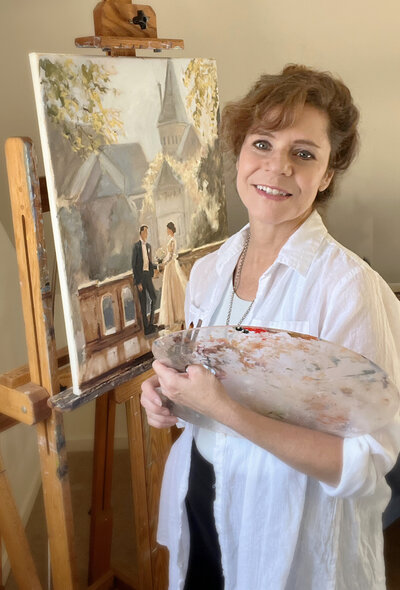





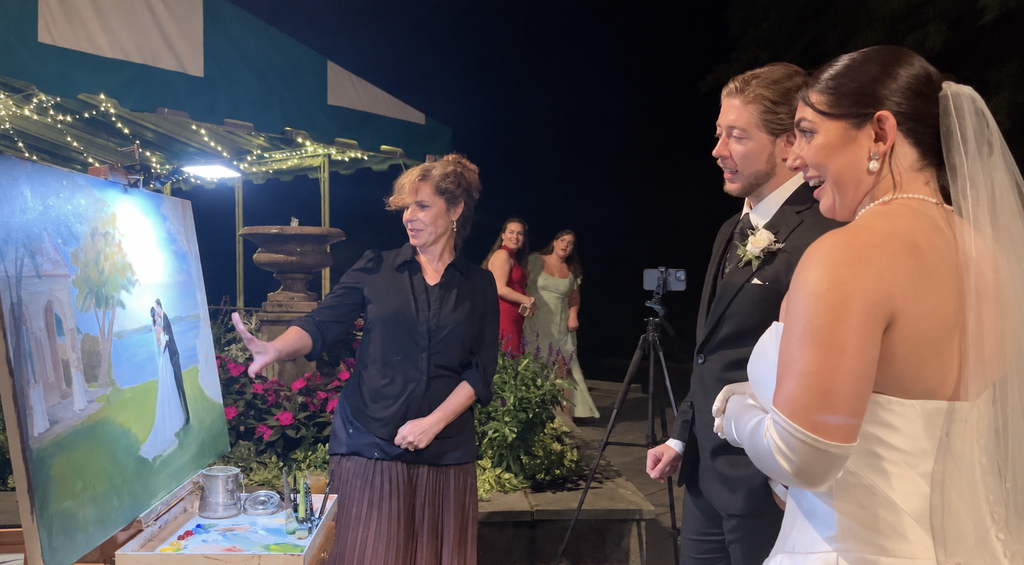
One of the first questions couples ask me when considering a live wedding painting is, “How do we decide what scene to have painted?”
And often, the next question is, “What size canvas should we choose?”
These are two important decisions, and they’re closely connected.
After painting at weddings throughout New England and beyond, I’ve learned that the best compositions begin with a conversation. My role isn’t simply to arrive at a wedding with my easel and paint whatever happens to be in front of me. I want to help each couple create a clear vision for a painting that reflects their wedding day, their personalities, and the memories they want to preserve.
Here’s how I guide couples through that process.
1. Start With the Setting and What Makes It Meaningful
A live wedding painting starts long before I set up my easel. It starts with listening.
When I first speak with a couple, I love to ask why they chose their wedding venue. What do they love about it? What made them decide this was the place where they wanted to celebrate their marriage?
Sometimes it’s the beautiful architecture of a historic mansion. Other times it’s a garden, a waterfront view, or the elegance of a ballroom.
Their answers help me understand what belongs in the painting.
For some couples, the venue itself holds a special meaning. They may have grown up visiting that part of the coast, or they may have chosen a historic property because of its architecture and gardens.
The couple will always be the focal point of my paintings, but the setting helps tell their story.
REAL WEDDING STORY 01 · THE SETTING
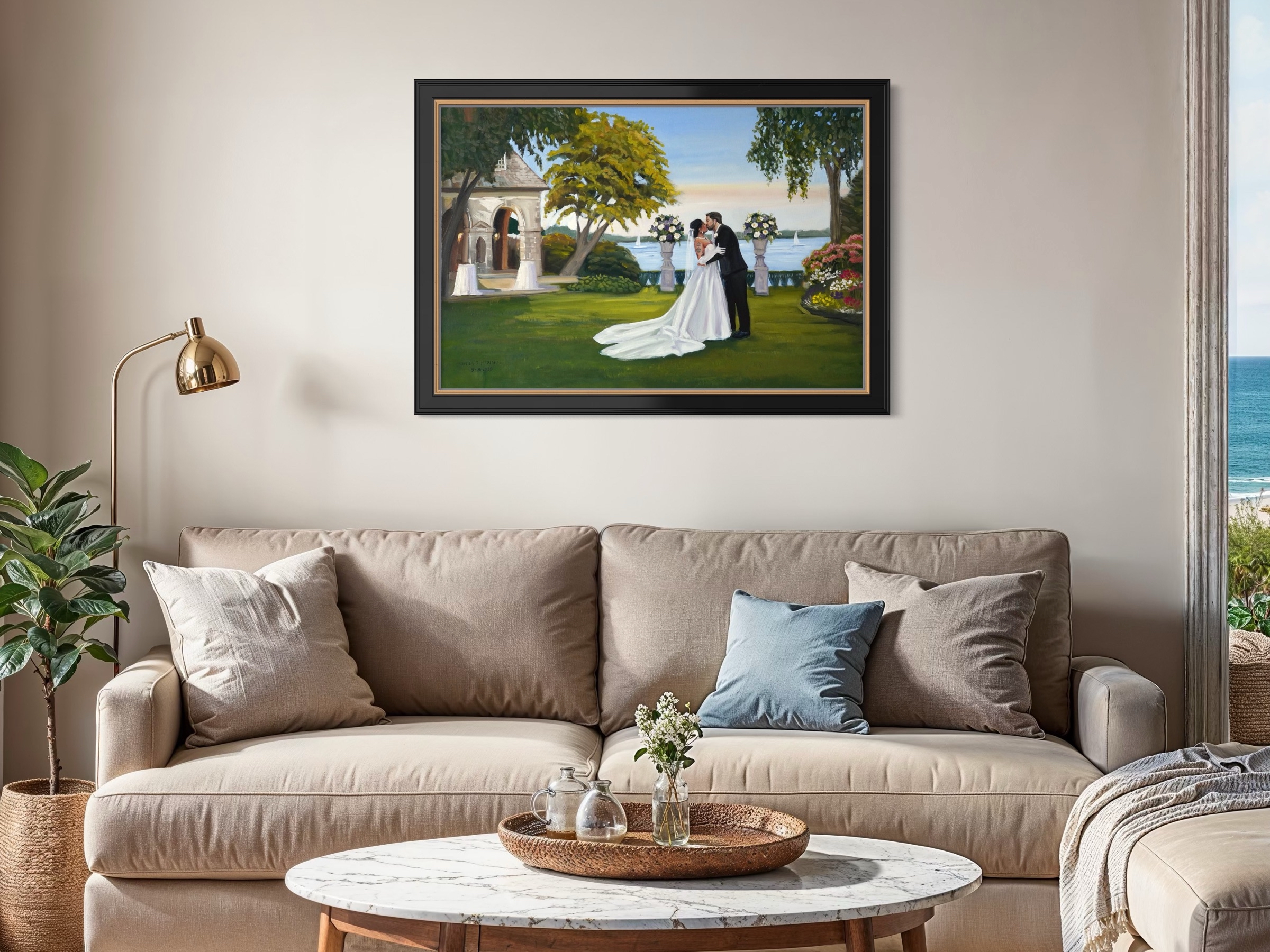
Julia & Steven — Glen Manor House, Portsmouth, Rhode Island
When I first spoke with Julia and Steven, they shared how excited they were to welcome family and friends to Rhode Island, where they were living at the time. With guests traveling to celebrate with them, they wanted their wedding painting to capture some of the beauty of the area.
I was already familiar with Glen Manor House, having painted there a few years earlier. Julia and Steven envisioned their first kiss at the conclusion of their outdoor ceremony, but they also wanted a portion of the historic mansion included.
We decided on a viewpoint behind the ceremony area that would allow me to capture the couple, part of the building and veranda, and the beautiful gardens to the right.
As we worked through the composition, we realized that increasing the canvas from 24 × 30 to 24 × 36 inches would give us the additional space needed to bring these elements together.
After seeing their painting, Julia and Steven shared these wonderful words:
“This is even better than our wildest dreams. You are absolutely incredible, we cannot thank you enough!”
Their painting is a lovely example of how choosing the right viewpoint and canvas proportions can help tell a more complete story.
2. Think About the Moment You Want to Remember
Once we talk about the setting, I ask couples to think about the moment they would most like to capture.
Would they love a painting of their ceremony, surrounded by the beautiful landscape where they exchanged their vows?
Perhaps they’ve spent months practicing their first dance and would love to remember that moment beneath the chandeliers of their reception ballroom.
Or maybe they envision a quiet, romantic moment with just the two of them, surrounded by the beauty of their venue.
There isn’t one right answer.
I encourage couples to think beyond what might make a beautiful photograph and consider what they want their painting to communicate.
Do they want something intimate and romantic? Or would they prefer a lively celebration filled with the warmth and energy of family and friends?
That distinction helps us begin shaping the composition.
REAL WEDDING STORY 02 · THE MOMENT
Kassy & John — Inn at Mystic, Mystic, Connecticut
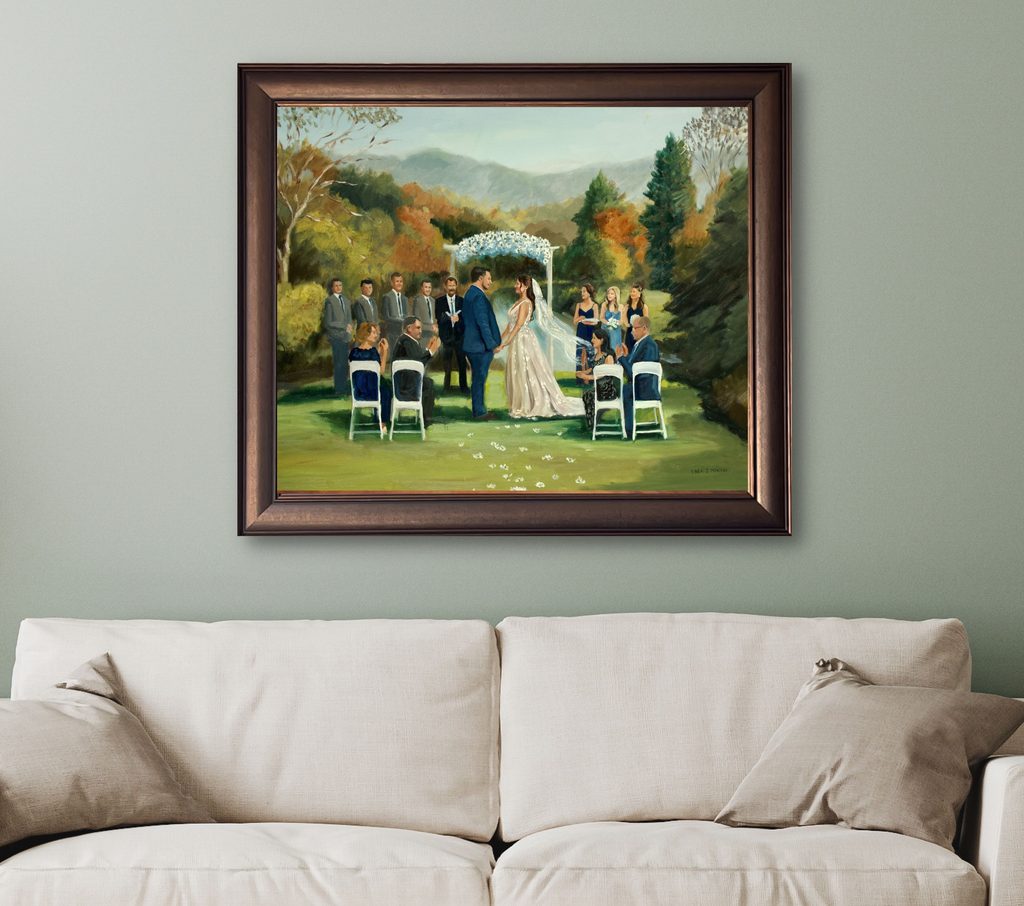
Kassy and John were living in the Washington, D.C., area, but with John’s Connecticut roots, they chose the Inn at Mystic for their early October wedding.
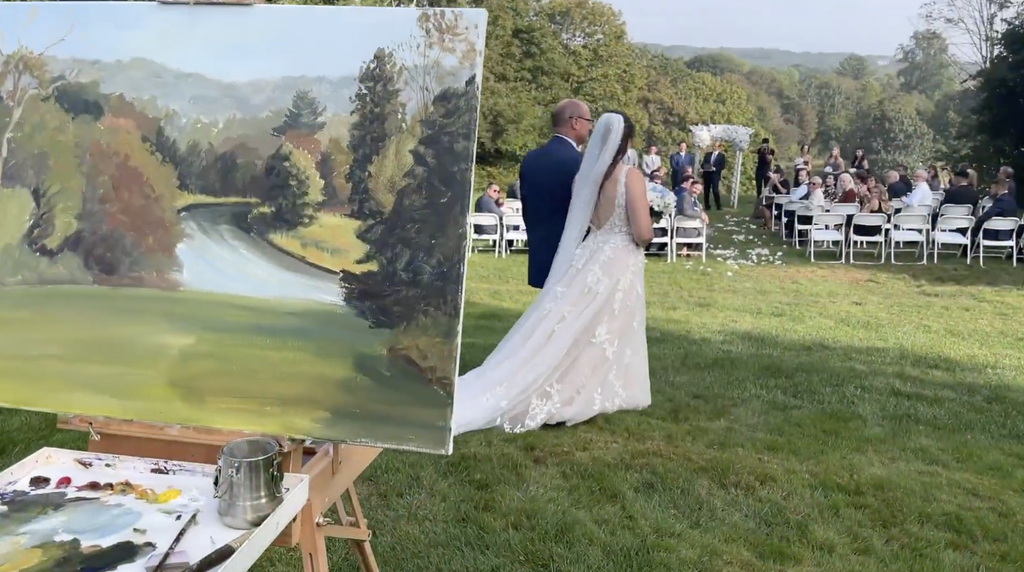
From our conversations, Kassy had a beautiful vision in mind. She wanted a landscape painting that captured the river, the early autumn colors, and the natural beauty surrounding their outdoor ceremony.
It was also important to include their wedding party and parents as part of the scene.
This wasn’t simply about painting the ceremony. Kassy wanted the landscape and the people they loved to share in the story.
By understanding those priorities, I could develop a composition that celebrated their wedding moment while allowing the Connecticut scenery to play an important role.
3. An Intimate Portrait or a Celebration Scene?
One of the most important choices is deciding how many people to include.
An intimate composition places the emphasis on the couple. Their expressions, body language, and the setting create the emotional connection.
A celebration scene tells a somewhat different story.
It might show the couple during their first dance, surrounded by family and friends, or a ceremony with guests gathered around them.
There are different ways to approach these larger compositions.
For example, in Anjuli and Patrick’s wedding painting at Belle Mer in Newport, Rhode Island, the surrounding guests are painted loosely. They create the feeling of a wonderful celebration without every person being individually recognizable.
This approach allows the couple to remain the focal point while still capturing the atmosphere and energy of the wedding.
Other couples want particular family members included and recognizable. In those cases, we discuss who should appear in the painting and how their placement will work within the composition.
Adding detailed portraits of family members requires additional planning and painting time, so it’s an important conversation to have early.
Neither approach is better. They simply tell different stories.
REAL WEDDING STORY 03 · THE PEOPLE
Kaitlin & Connor — The Red Barn at Hampshire College, Amherst, Massachusetts
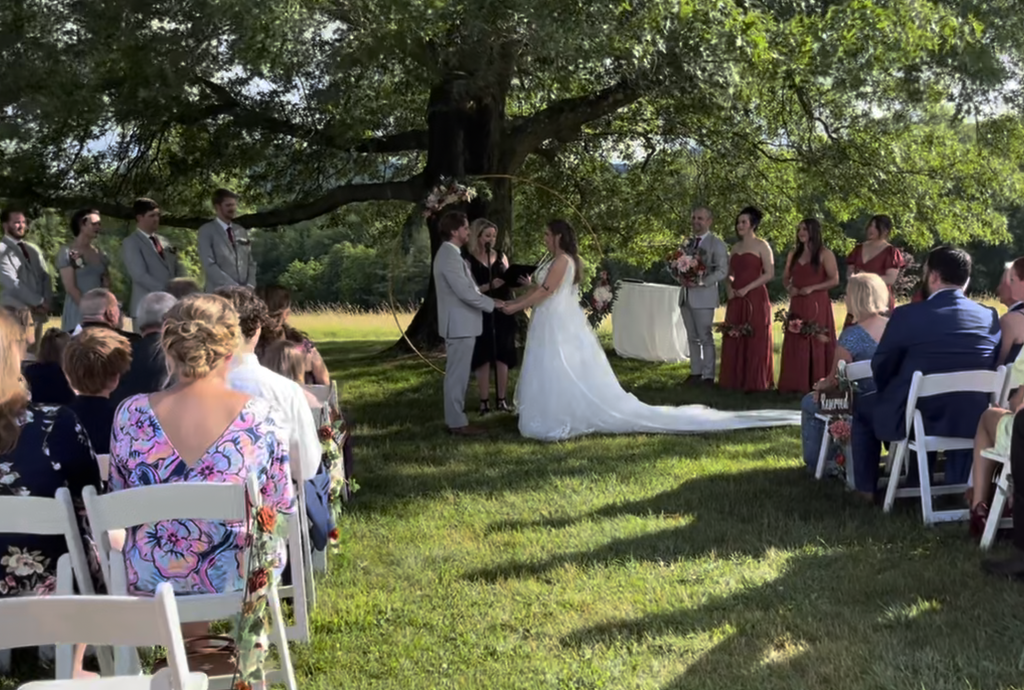
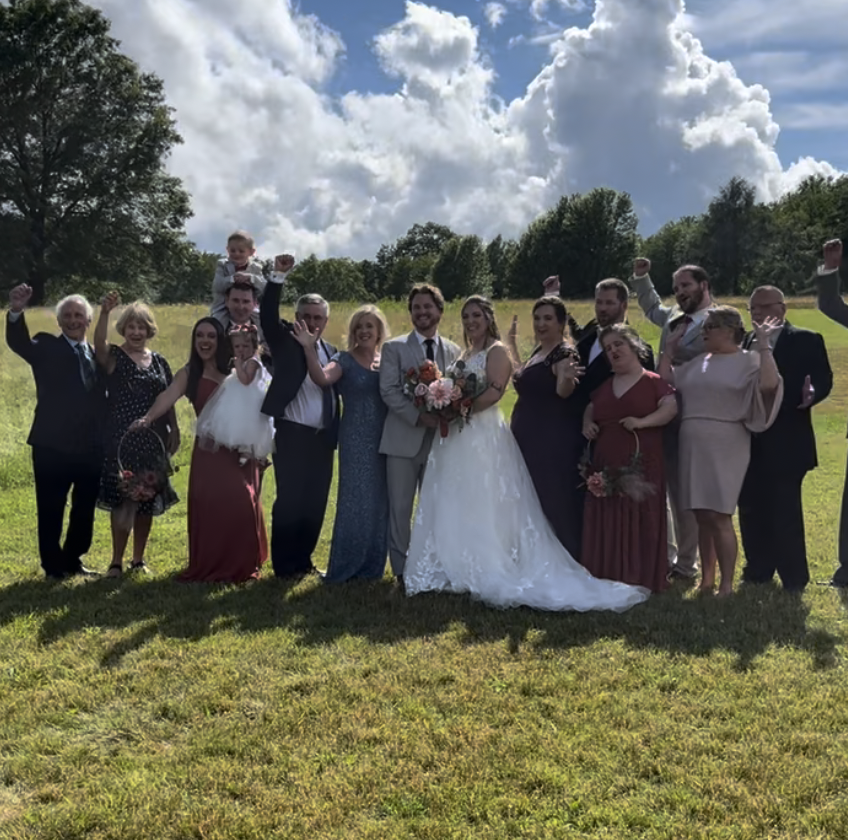
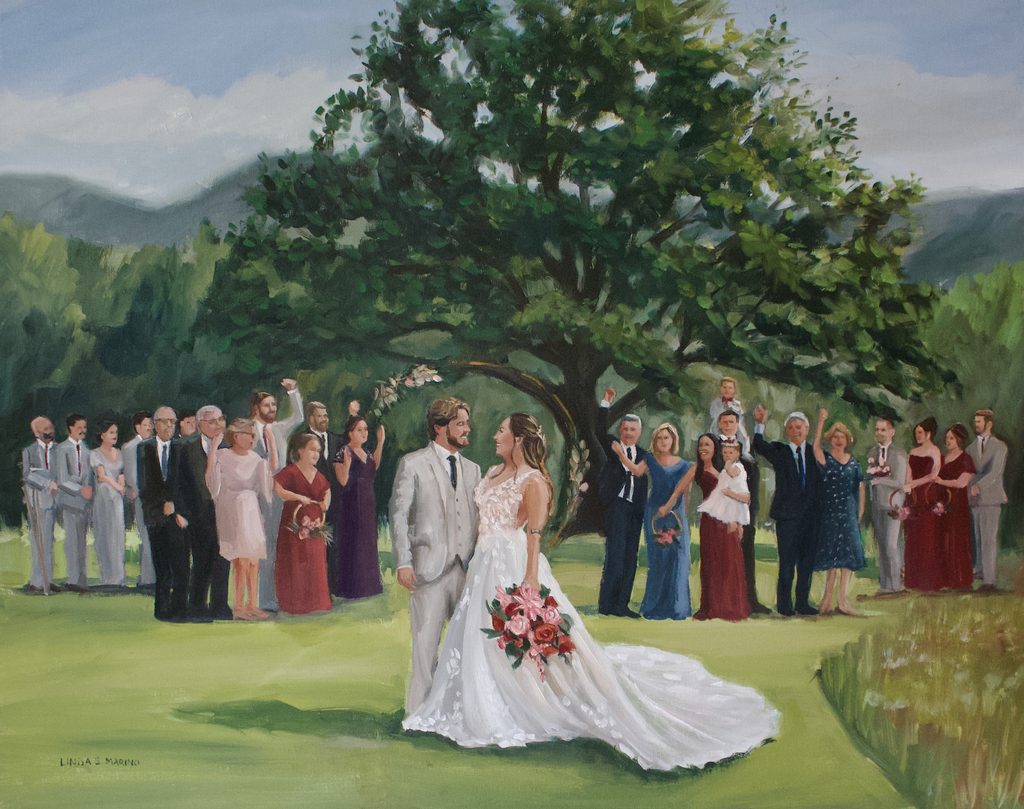
Kaitlin and Connor’s wedding painting was a thoughtful gift from Kaitlin’s brother, Thomas.
Their wedding was a smaller, intimate celebration, and the vision for the painting was filled with joy. They wanted to capture the moment they walked away from their ceremony, surrounded by their cheering family and wedding party.
But there was another important element in the scene: a magnificent oak tree.
During their college years, Kaitlin and Connor would meet beneath this tree, making it a meaningful part of their story.
Including the tree, along with the family and friends celebrating around them, created a composition that was both personal and full of life.
It’s a wonderful reminder that a celebration scene doesn’t need to be about a large crowd. Sometimes it’s about including a few special people and a place that holds extraordinary meaning.
4. How Do You Choose the Right Canvas Size?
Canvas size is another important consideration, and I usually discuss it alongside the composition.
I begin by asking where the couple plans to display the finished painting.
Will it hang over a fireplace, in a dining room, above a sofa, or in a more intimate space?
I also consider how much of the scene they would like to include.
For my live wedding paintings, I work with several canvas sizes, including 24 × 30, 24 × 36, 30 × 40, and 36 × 48 inches.
A 24 × 30-inch canvas can be a beautiful choice for a composition focused primarily on the couple, with selected architectural or landscape details.
A larger canvas, such as 30 × 40 inches, provides more room for an expansive setting, elaborate architecture, or additional figures.
For a particularly grand scene with many important elements, a 36 × 48-inch canvas may be a better choice.
But larger doesn’t automatically mean better.
What matters is choosing proportions that complement the composition and allow the most important elements to have the visual presence they deserve.
I also remind couples to consider the finished framed dimensions, since the frame adds to the overall size of the artwork.
My goal is to recommend a canvas that works both artistically and beautifully in their home.
REAL WEDDING STORY 04 · CANVAS SIZE
Abigail & Michael — Wadsworth Mansion, Middletown, Connecticut
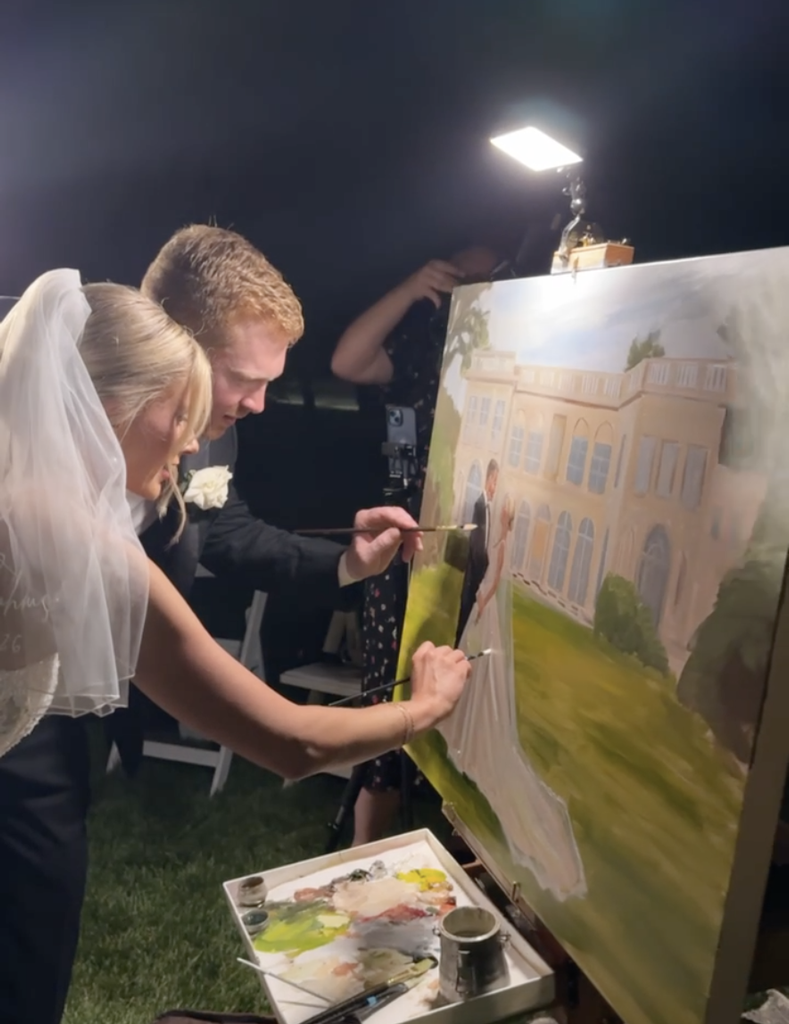
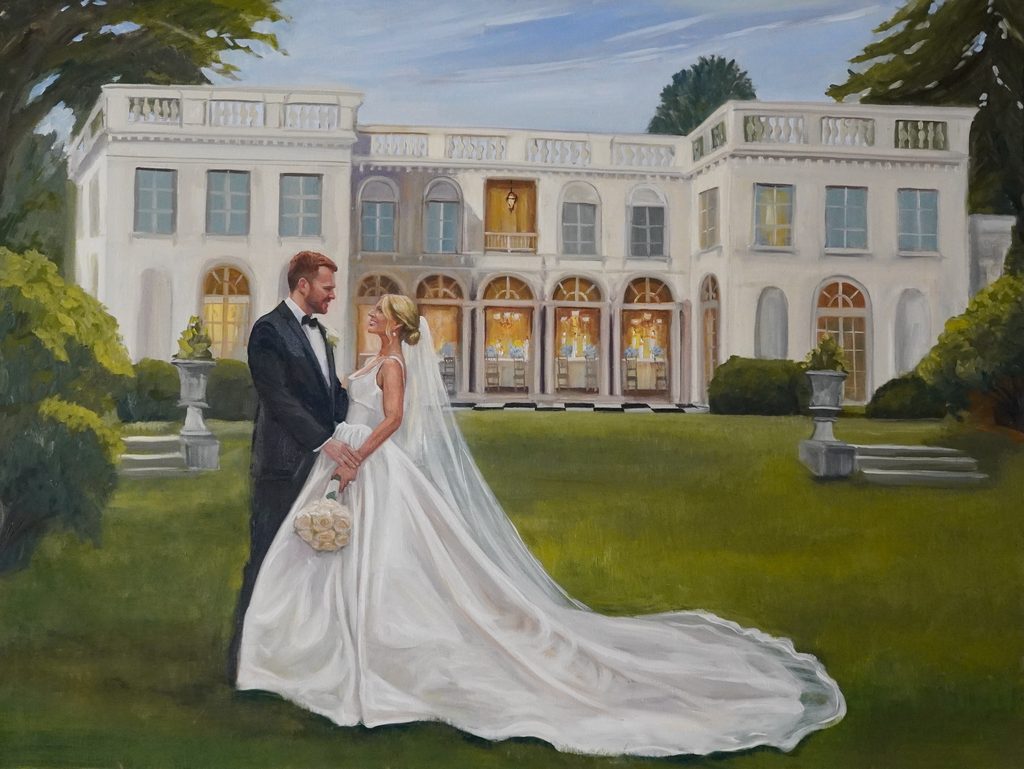
For Abigail and Michael’s wedding, the magnificent architecture of Wadsworth Mansion was an essential part of their vision.
They wanted the painting to capture the grandeur of the historic building while keeping the two of them as the focal point.
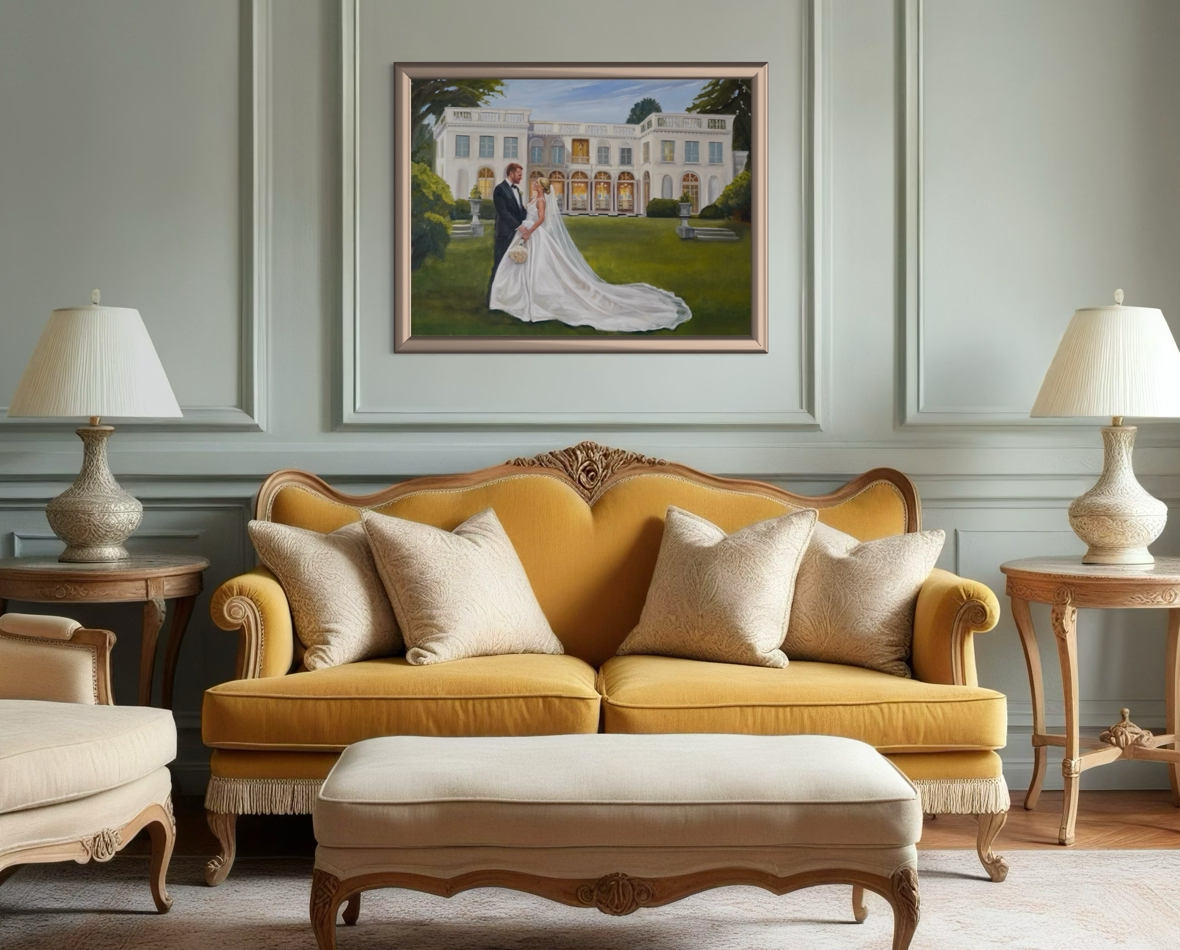
They had also recently moved into a new home and knew exactly where they wanted to display their painting.
We discussed the dimensions of the wall, including the decorative molding, and even considered the size of the finished frame to make sure everything would fit beautifully.
We selected a 30 × 40-inch canvas, which provided the space needed to capture the mansion’s impressive architecture without diminishing the importance of the couple.
A smaller canvas simply wouldn’t have served this particular composition as well.
This is why I encourage couples to think about both the scene they want to remember and where the finished painting will live. The right canvas size should complement the composition and the space where it will be enjoyed for years to come.
5. Using Sketches to Help Couples Visualize Their Painting
Sometimes a couple has a very clear idea of what they want. Other times, they know how they want the painting to feel but have trouble imagining the final composition.
That’s where my preparation and sketches can be especially helpful.
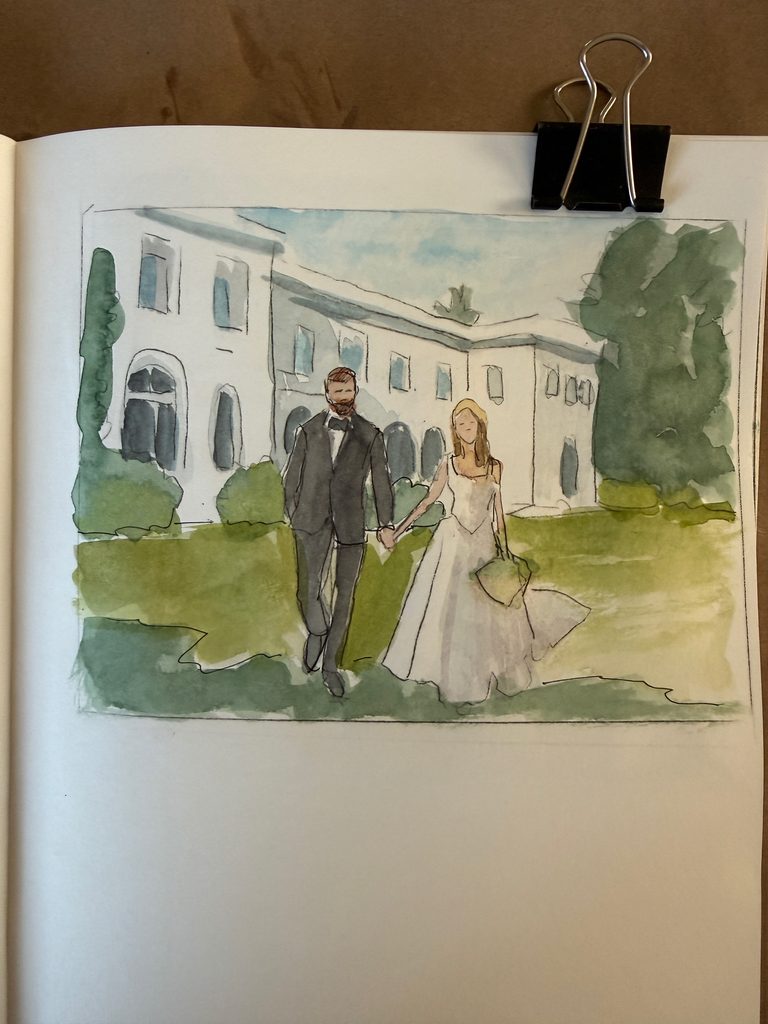
For Abigail and Michael’s wedding at Wadsworth Mansion in Middletown, Connecticut, the bride wanted to capture the elegance of the mansion’s architecture.
My husband and I visited the property about a month before their wedding so I could study the grounds, take reference photographs, and consider different viewpoints.
I created preliminary sketches to help the couple see how the mansion and their figures could work together within the composition.
We discussed the angle, the scale of the building, and how to make sure the couple would remain an important focal point.
I then made another sketch to refine the idea.
This collaborative process is one of my favorite parts of creating a commissioned painting. I bring my knowledge of composition, perspective, color, and scale, while the couple shares the personal details that make the painting meaningful.
Together, we arrive at a vision that feels right.
REAL WEDDING STORY 05 · SKETCHES
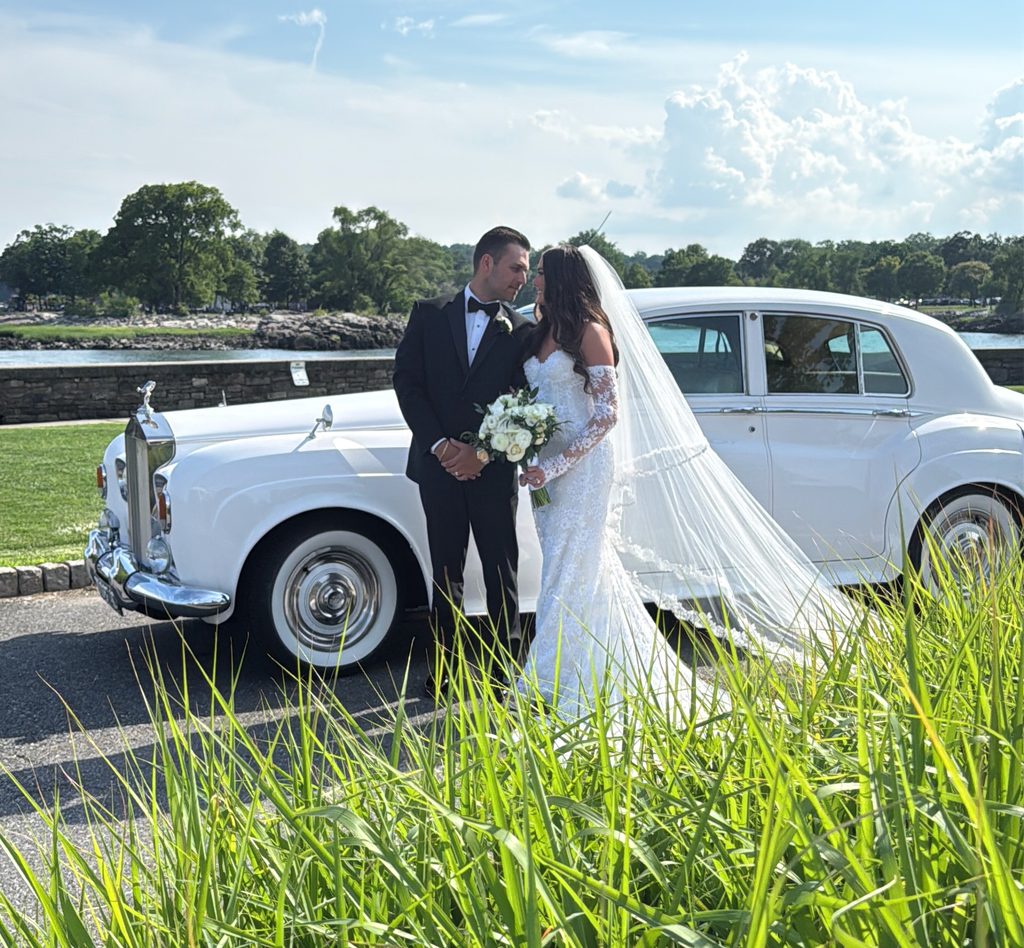
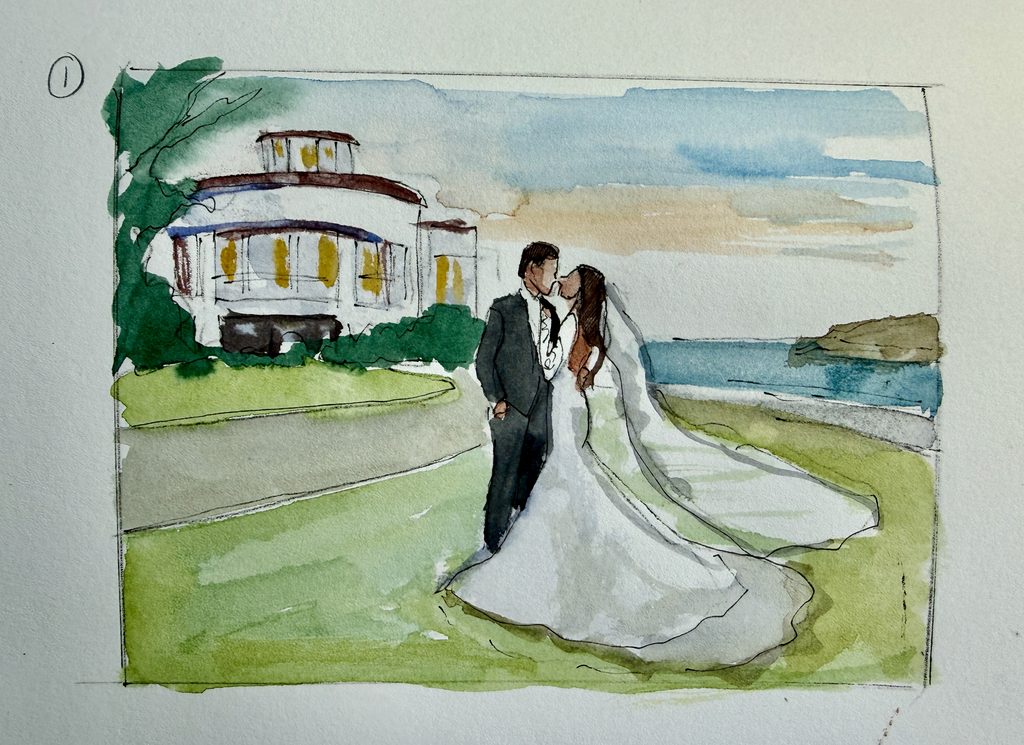
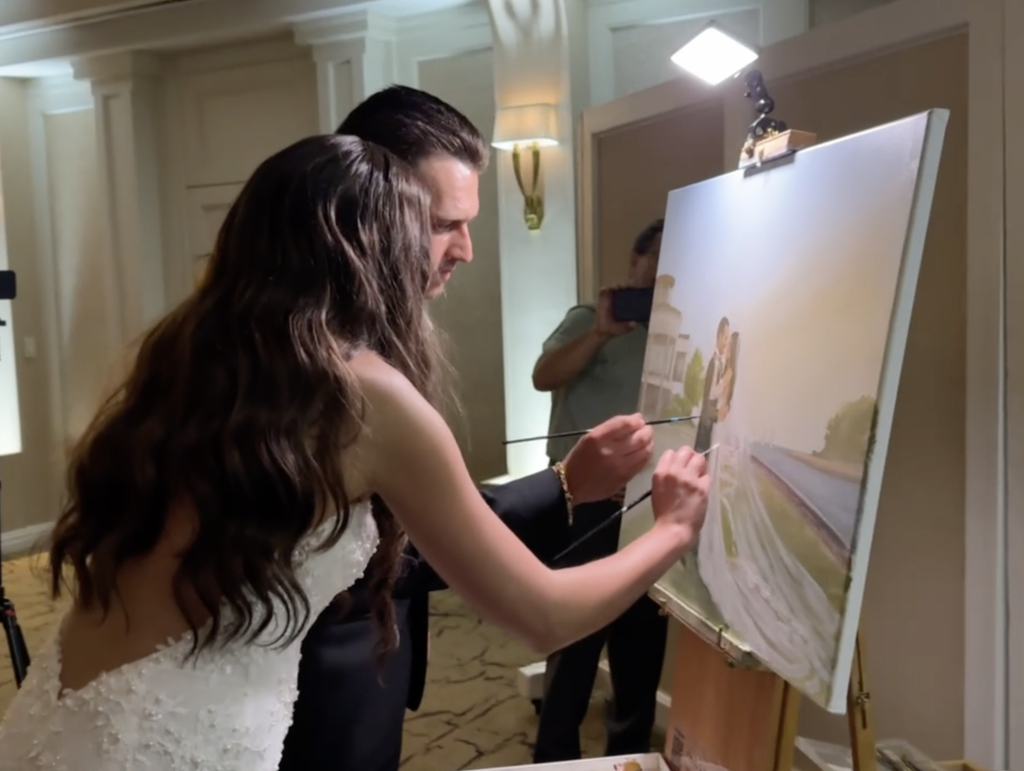
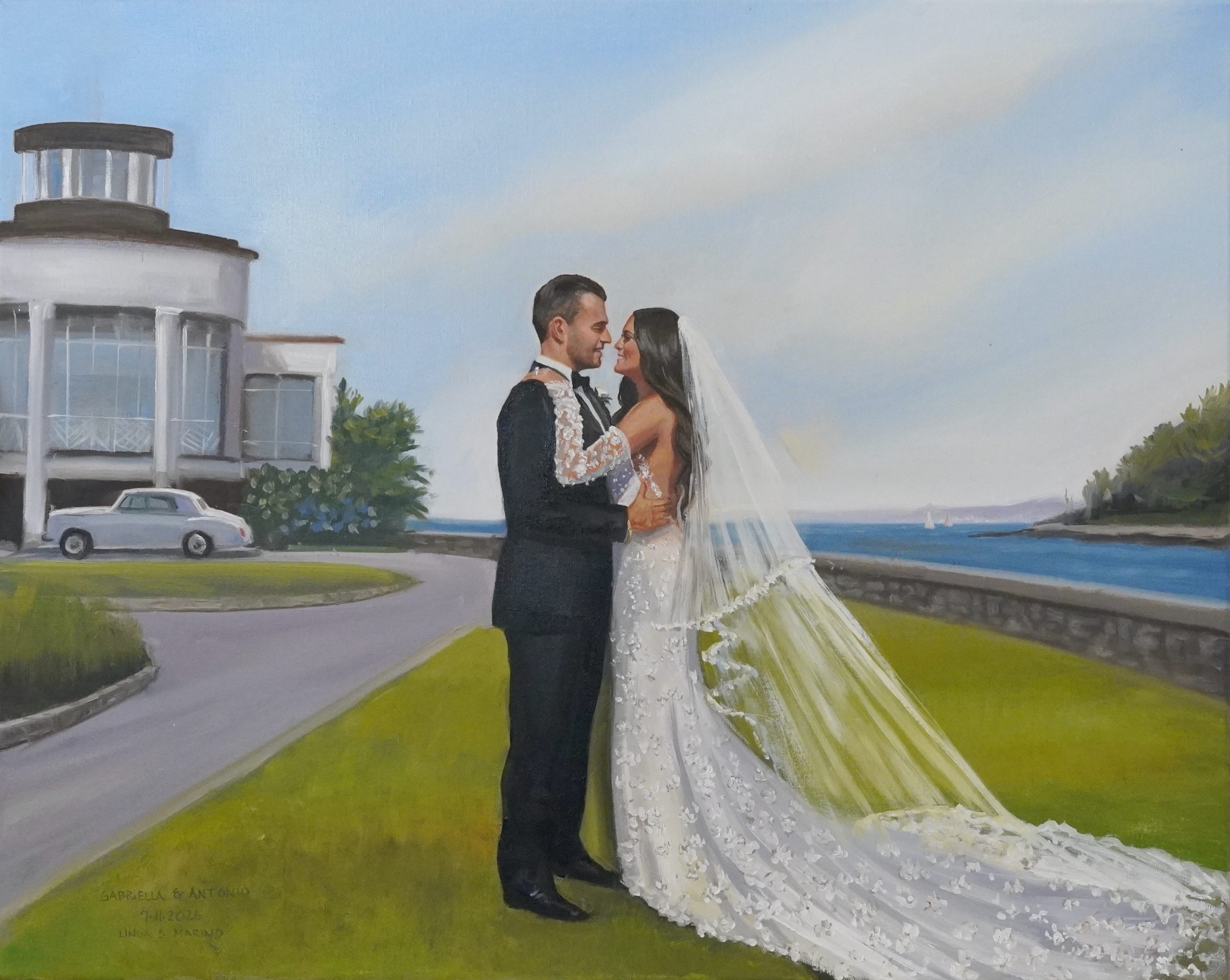
Gabriella & Antonio — Glen Island Harbour Club, New Rochelle, New York
When Gabriella and Antonio began planning their wedding painting, Gabriella had a clear vision of an outdoor landscape scene that would include part of Glen Island Harbour Club and its beautiful grassy lawn.
There was also a special detail she wanted to remember: their arrival at the venue in a vintage Rolls-Royce.
To help them visualize the possibilities, I prepared several preliminary sketches exploring different placements for the couple and the car, along with different poses.
These sketches gave Gabriella and Antonio an opportunity to see how the elements might work together and decide which arrangement they preferred.
This is one of the reasons I find preliminary sketches so helpful. They allow us to explore the composition before the wedding day and make thoughtful decisions about what belongs in the painting.
Sometimes a small adjustment in placement or perspective can make a tremendous difference in the final work.
6. Preparing for the Venue and Having a Rain Plan
Once we’ve established the scene, I begin preparing for the wedding day.
I research the venue, looking through photographs, videos, and other visual references to understand its layout, architecture, and lighting.
If the venue is nearby and I haven’t visited recently, I may arrange to see it in person.
I also consider the time of day and how the light might change during the celebration.
For outdoor wedding paintings, I always encourage couples to discuss a rain plan.
New England weather can be unpredictable, and an outdoor ceremony may need to move indoors.
We can discuss whether the painting should still represent the originally planned outdoor scene or whether an alternate interior composition might be appropriate.
Having that conversation before the wedding gives us flexibility if the weather changes.
REAL WEDDING STORY 06 · WEATHER & PREPARATION
Emily & Tom — Newport Yachting Center, Newport, Rhode Island
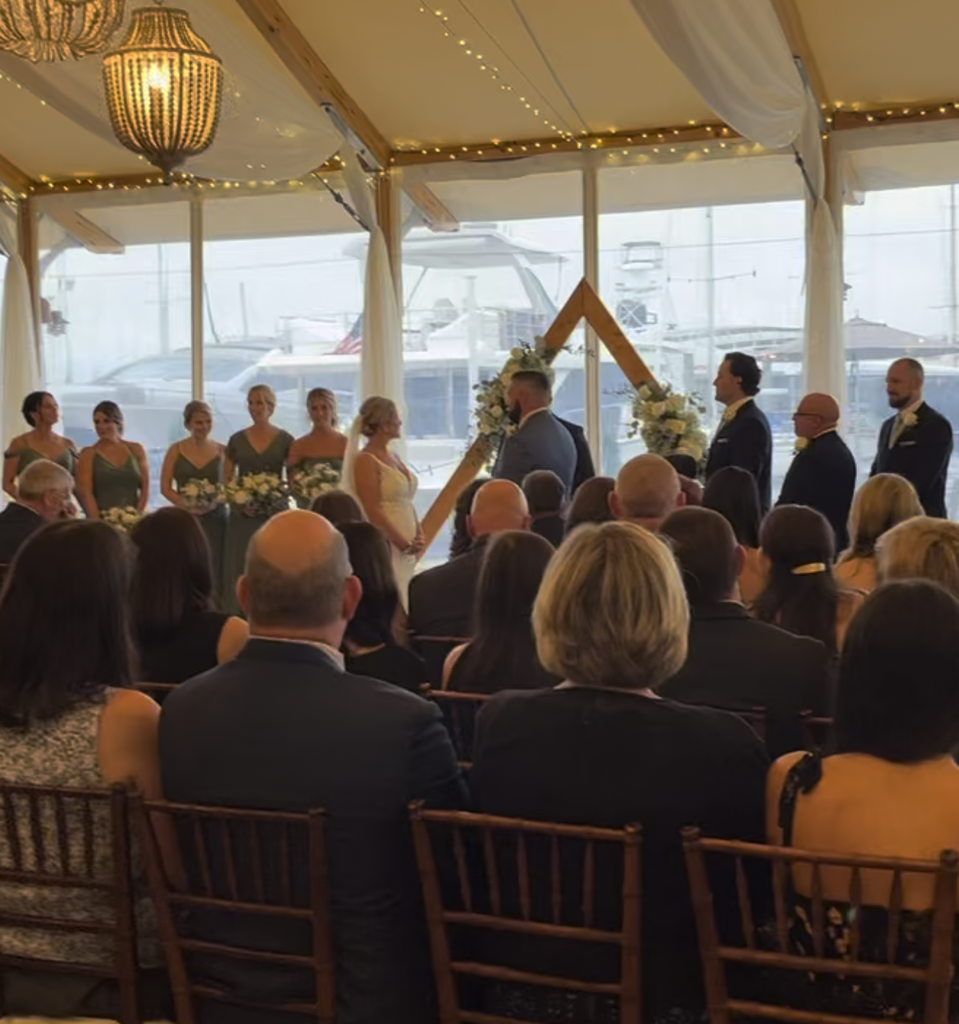
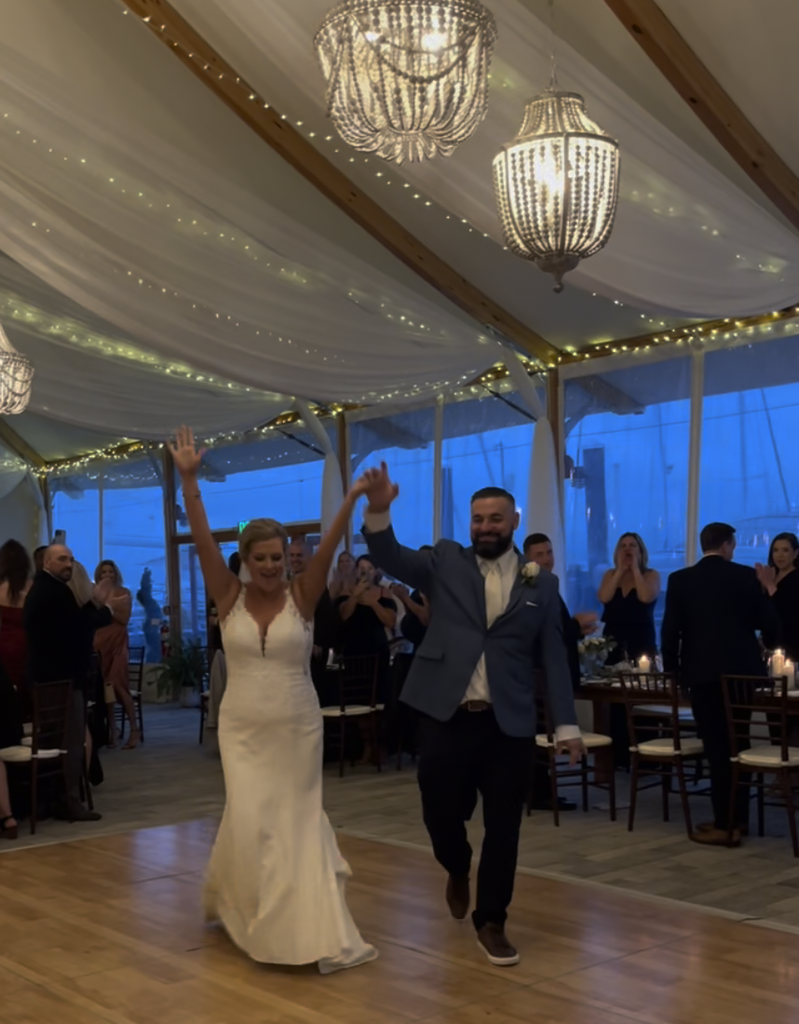
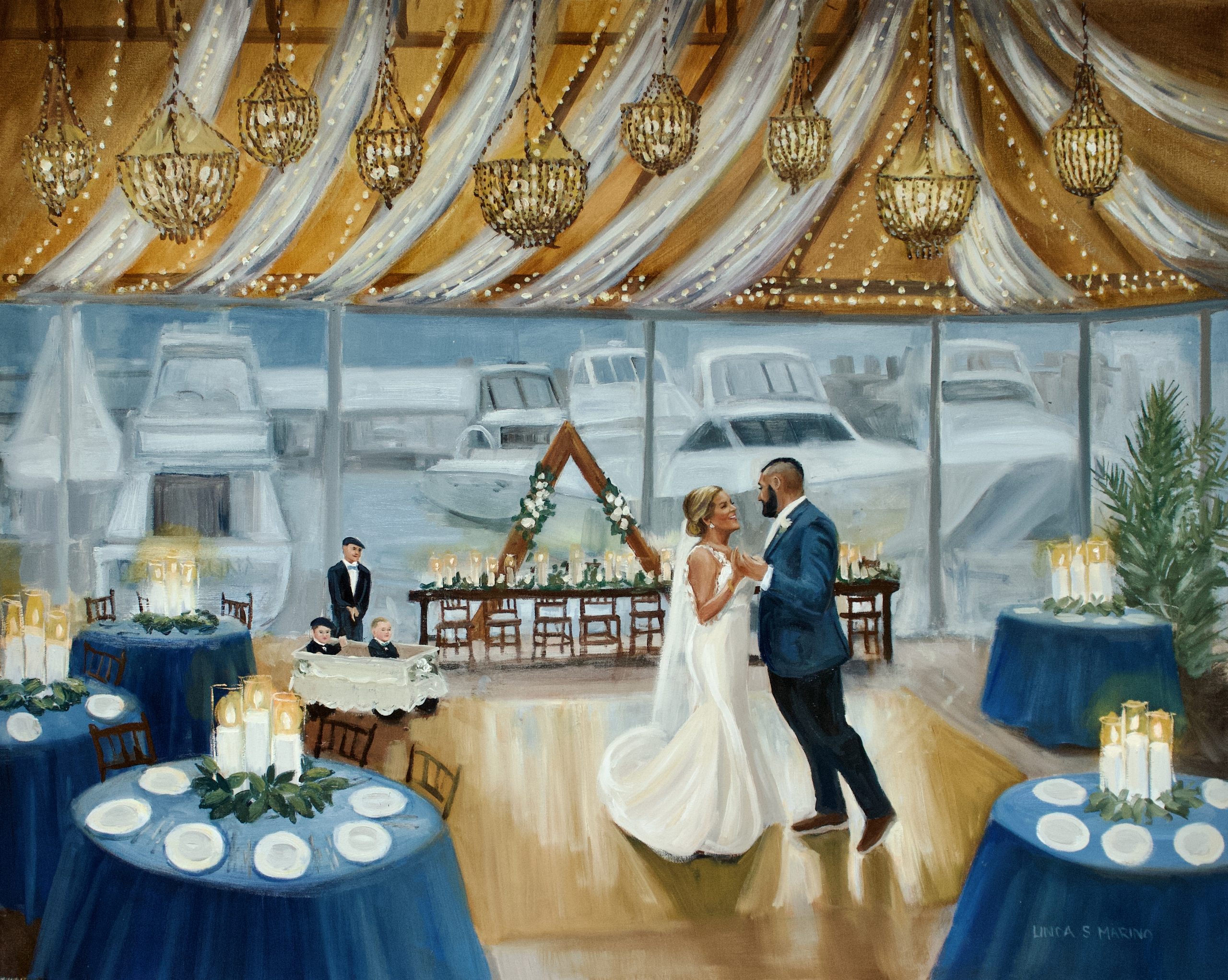
Emily and Tom had originally planned an outdoor ceremony on the dock at Newport Yachting Center, but the weather had other ideas.
Rain moved their ceremony indoors to the reception space.
Although no couple hopes for rain on their wedding day, an unexpected change in plans can sometimes create a beautiful opportunity for a painting.
Indoor scenes on rainy days often have a wonderful balance of warm interior lighting and cooler natural light coming through the windows.
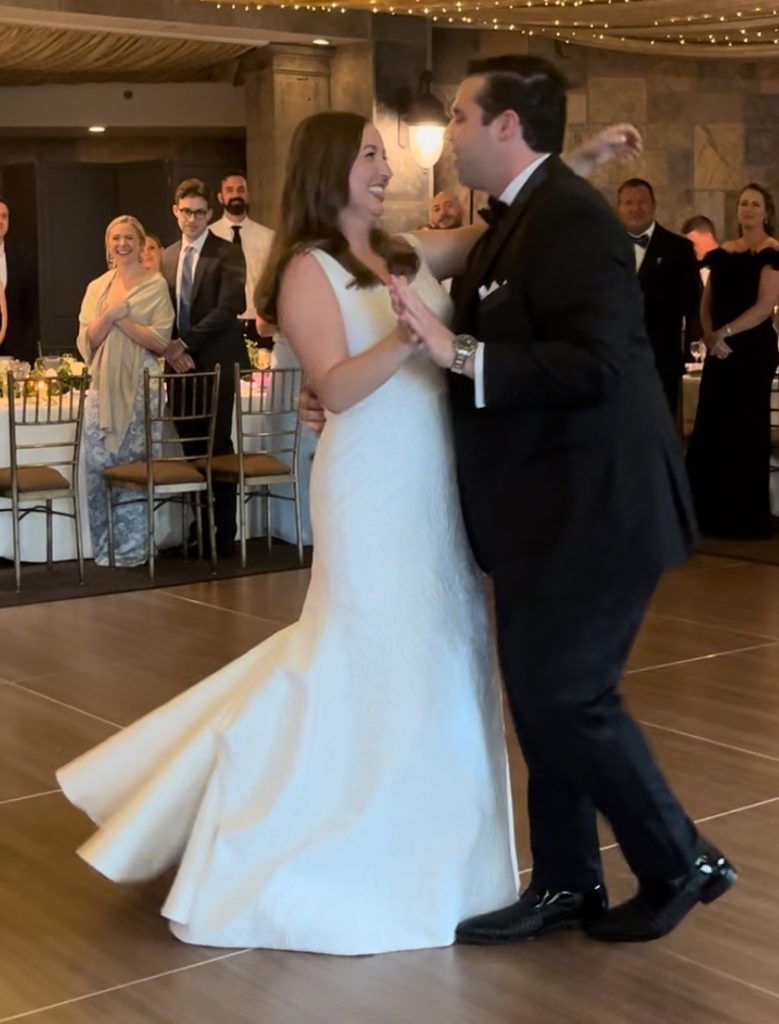
For Emily and Tom, we captured their first dance, with Emily’s children included in the background.
The resulting scene preserved a meaningful family moment while embracing the atmosphere of the celebration as it unfolded.
This is why I always encourage couples planning an outdoor painting to discuss a rain plan in advance. A little flexibility allows us to create something beautiful, even when the day unfolds differently than expected.
7. Trust the Creative Process
Even with careful planning, a live wedding painting is a work of art that develops over time.
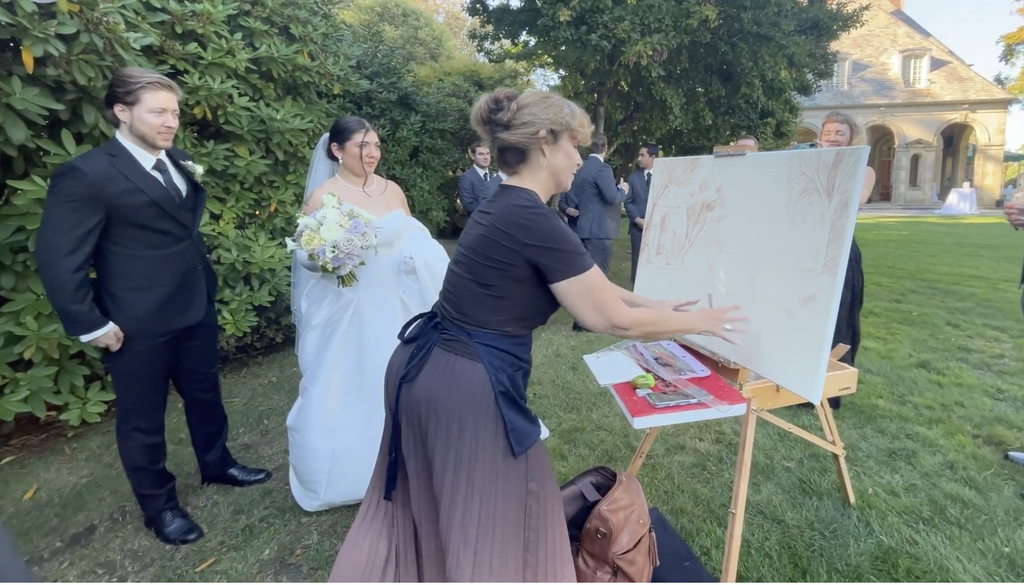
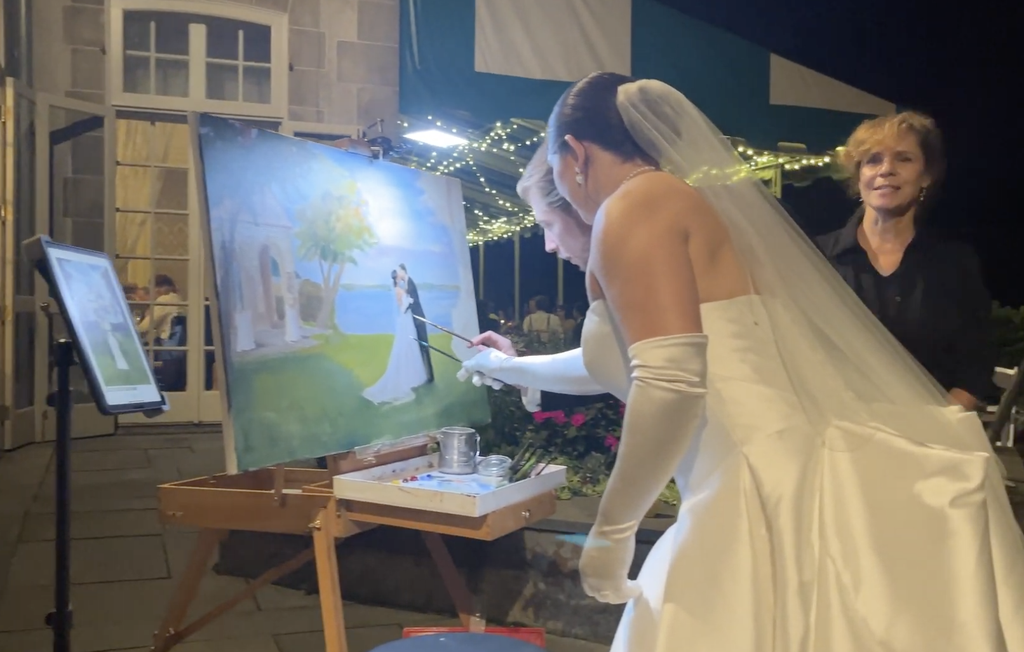
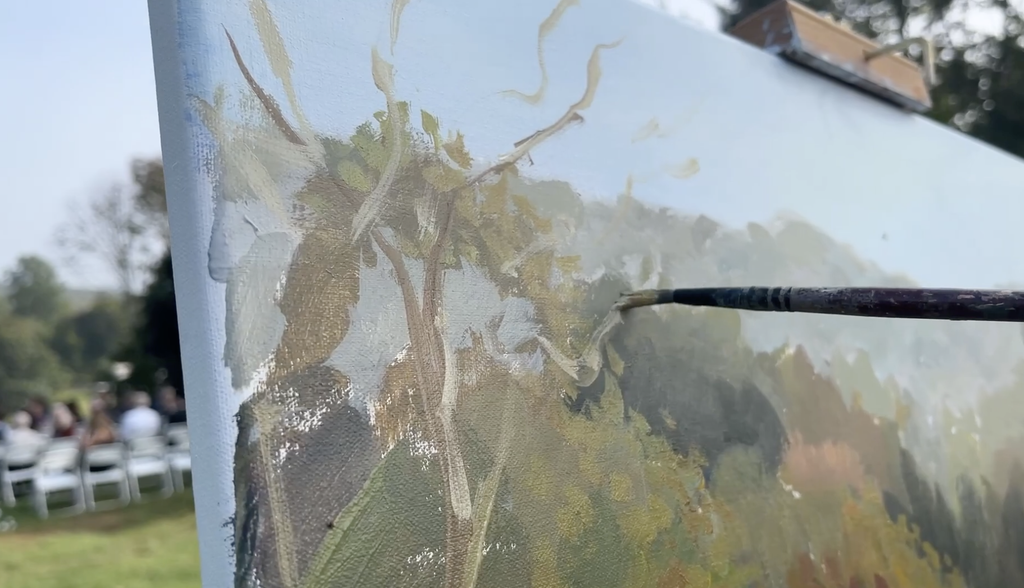
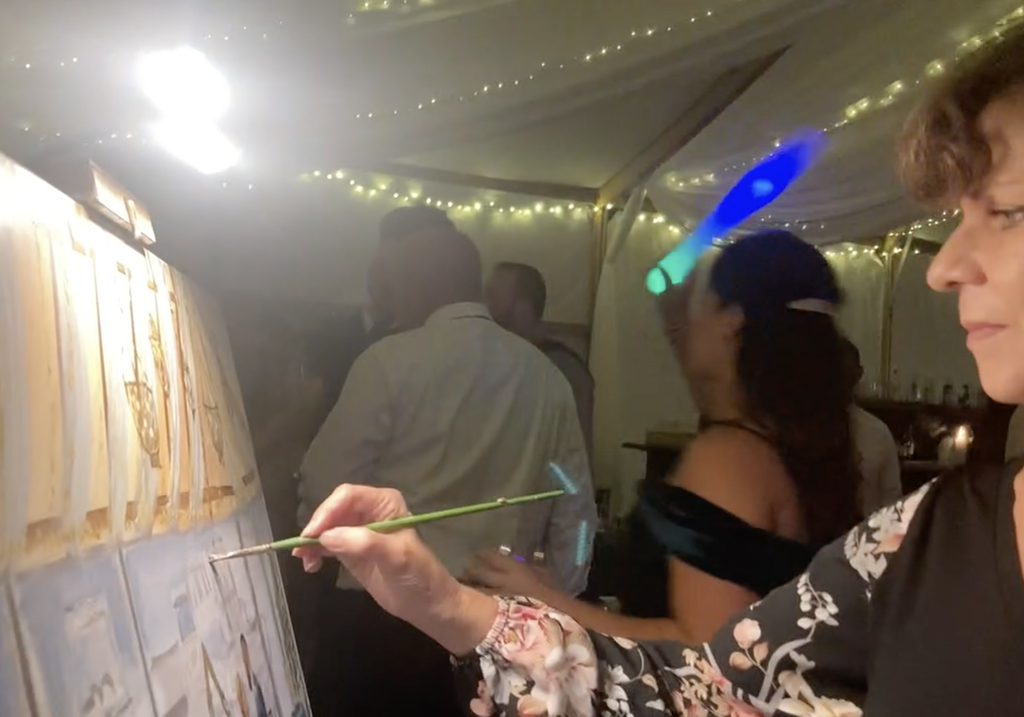
I begin painting on location in acrylics, capturing the composition, colors, light, and atmosphere of the celebration while guests watch the painting come to life.
After the wedding, I bring the canvas back to my studio, where I continue refining the painting in oils.
This additional studio time allows me to develop the figures, architecture, and details with the care they deserve.
The finished painting is more than a record of a single moment. It’s a carefully composed work of art that brings together the setting, the people, and the memories that made the wedding meaningful.
REAL WEDDING STORY 07 · THE CREATIVE PROCESS
Morgan & Brad — Tappan Hill Mansion, Tarrytown, New York
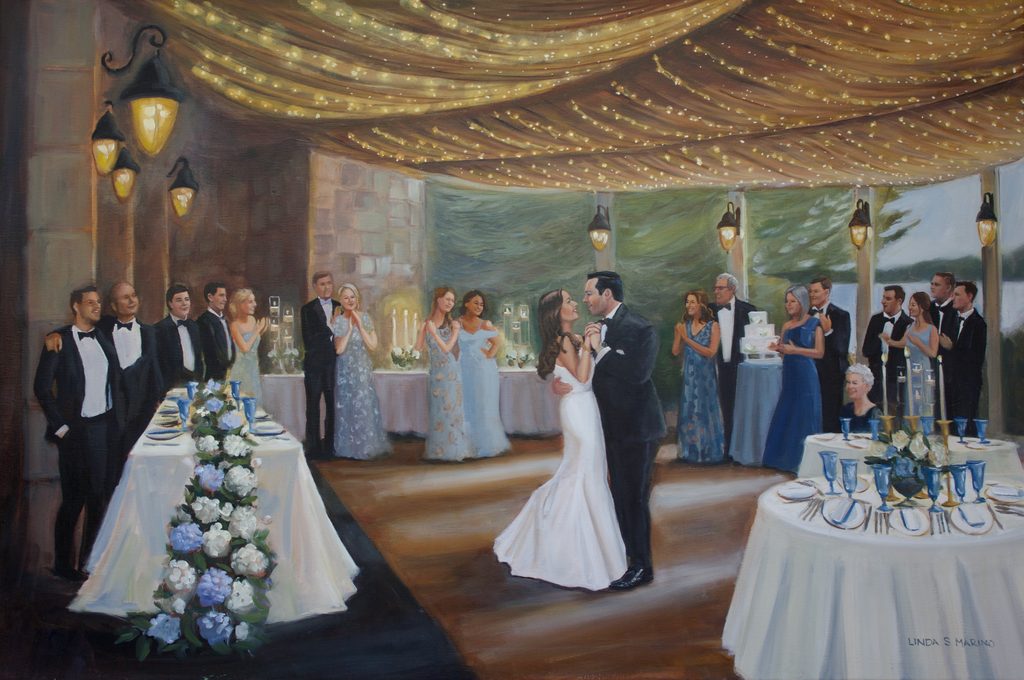
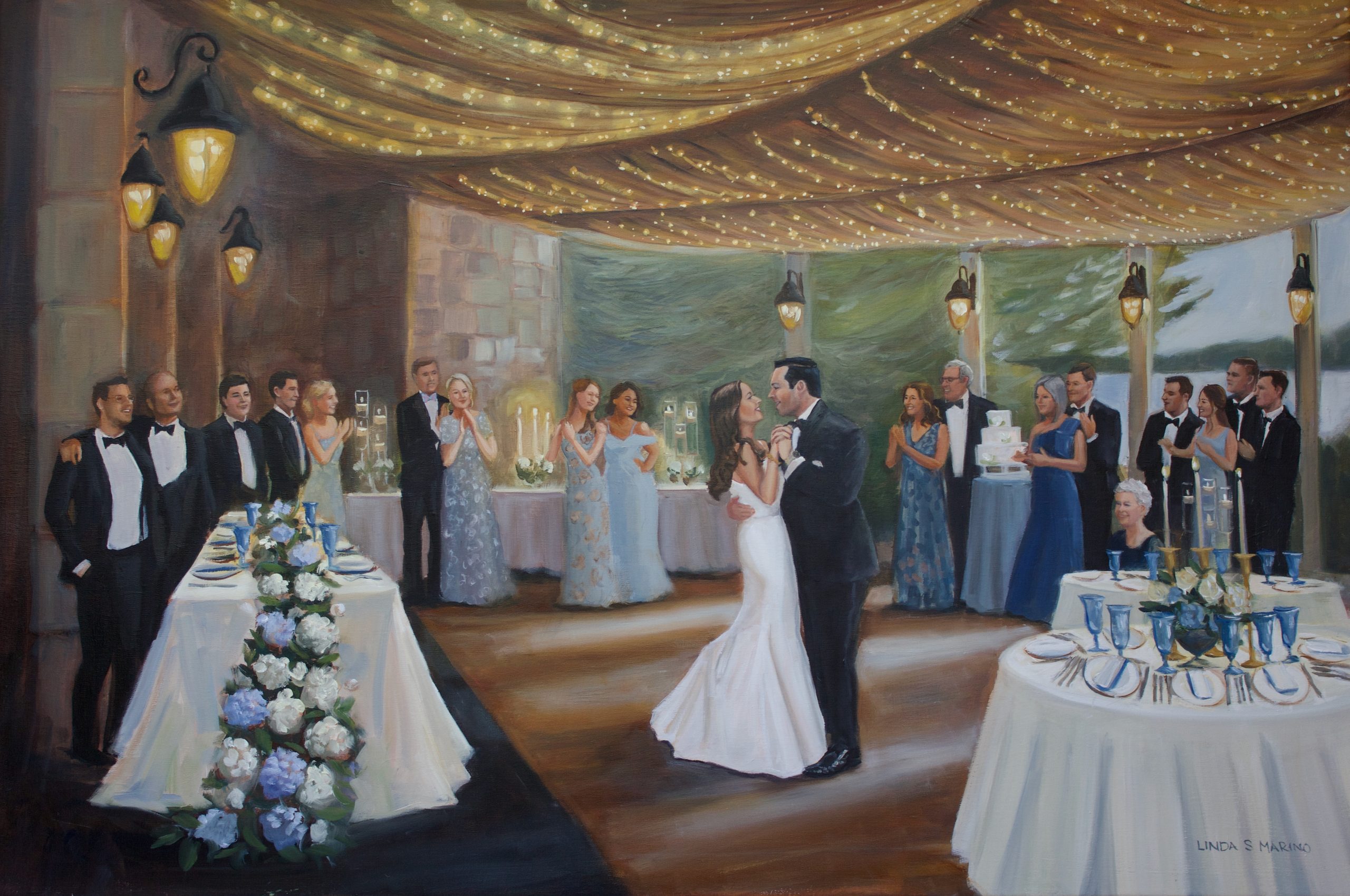
Morgan and Brad envisioned a celebration scene filled with the people closest to them.
Their painting would ultimately include 24 people, including their parents and wedding party, set against the beautiful interior of Tappan Hill Mansion.
The room itself was an important part of the composition, with its cool brown stone, dramatic panoramic windows, and views overlooking the Hudson River.
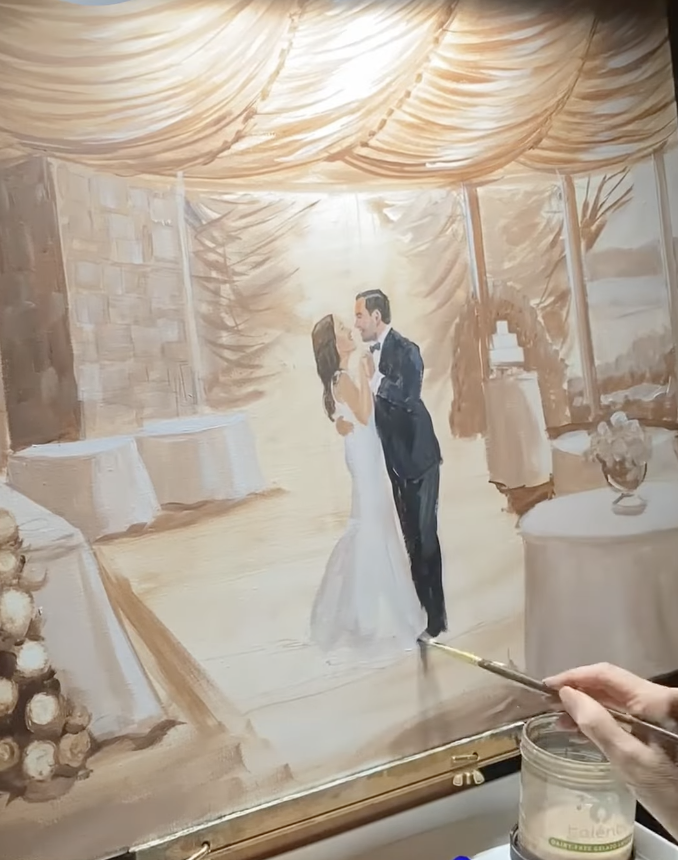
On the wedding day, I concentrated on establishing the composition, the room, and Morgan and Brad as the focal point.
I worked primarily in burnt umber, creating a warm underpainting that would serve as the foundation for the architectural details and the figures I would develop later in my studio.
With so many people included, the additional studio work was essential. It allowed me to carefully develop the individual portraits and bring the entire celebration together.
Morgan and Brad were delighted with the finished painting. In their review, they shared:
“The final product is so beautiful and we are so happy with it! It is something we are going to cherish forever.”
Their painting is a wonderful example of why live wedding painting is a process that continues beyond the wedding day. The work I begin in front of guests becomes the foundation for a carefully developed, finished oil painting.
Your Wedding Painting Should Tell Your Story
If you’re considering a live wedding painting, you don’t need to have every detail figured out before speaking with an artist.
Start by thinking about what matters most to you.
Is it the place where you’re getting married? The people who will be there? A special moment you’ve been looking forward to? Or simply the feeling of being surrounded by everyone you love?
Those conversations are where a meaningful painting begins.
And with thoughtful planning, the right composition, and a canvas size suited to your vision, your wedding painting can become an heirloom that brings those memories back for generations.
You can explore more examples of my work in my live wedding painting portfolio, or contact me to discuss your own wedding painting.
