



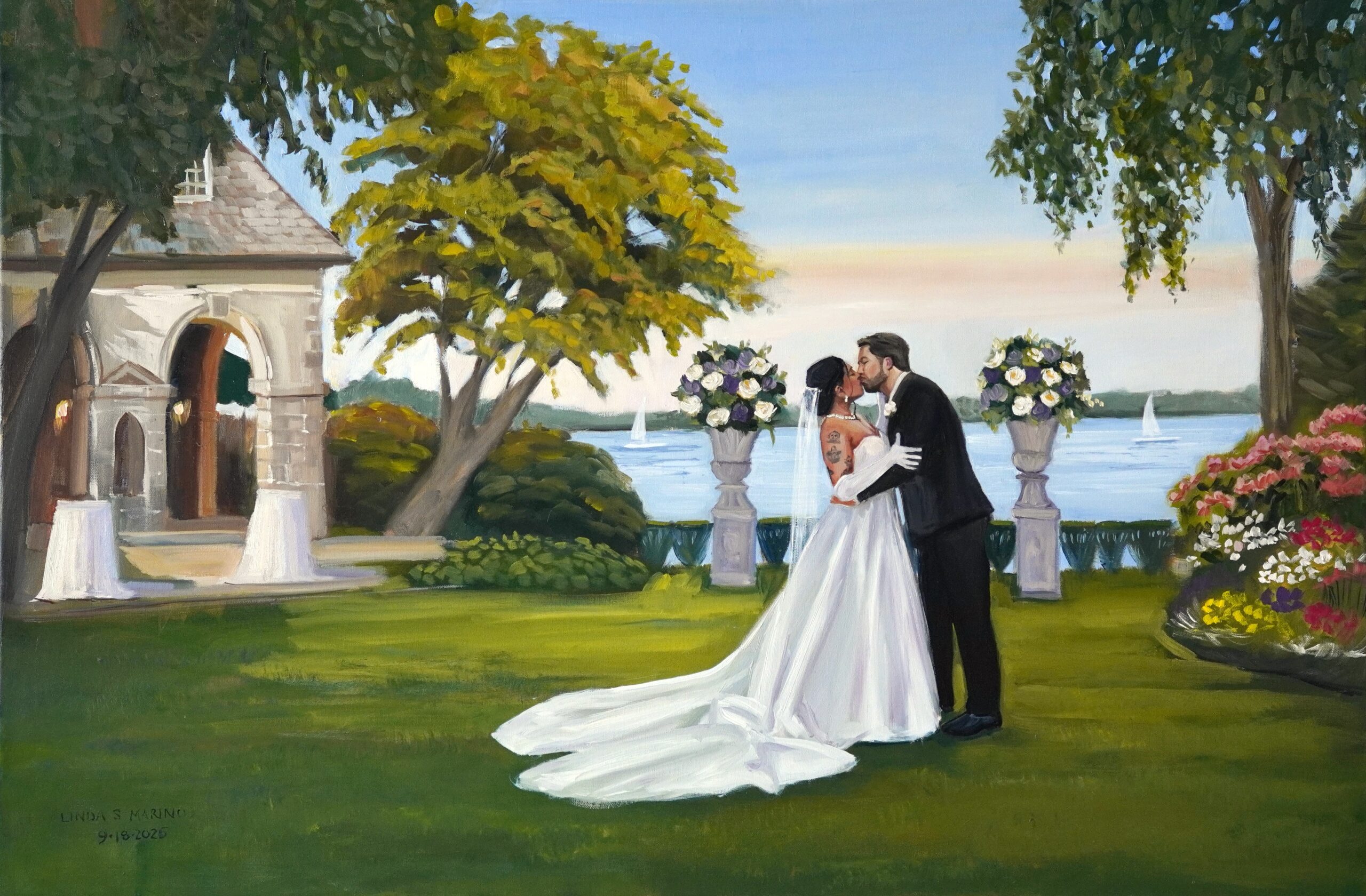
From the Gardens at Harkness to Julia & Steven’s First Kiss at Glen Manor House
In my last post, I shared why painting small outdoors builds confidence and sharpens your instincts.
The natural next step?
Painting large — on location.
There is something entirely different about standing in a garden with a 24 x 36 inch canvas on your easel. The scale forces you to think differently. It demands structure, clarity, and restraint. And that discipline is exactly what prepares me for weddings like Julia and Steven’s at Glen Manor House in Portsmouth, Rhode Island.
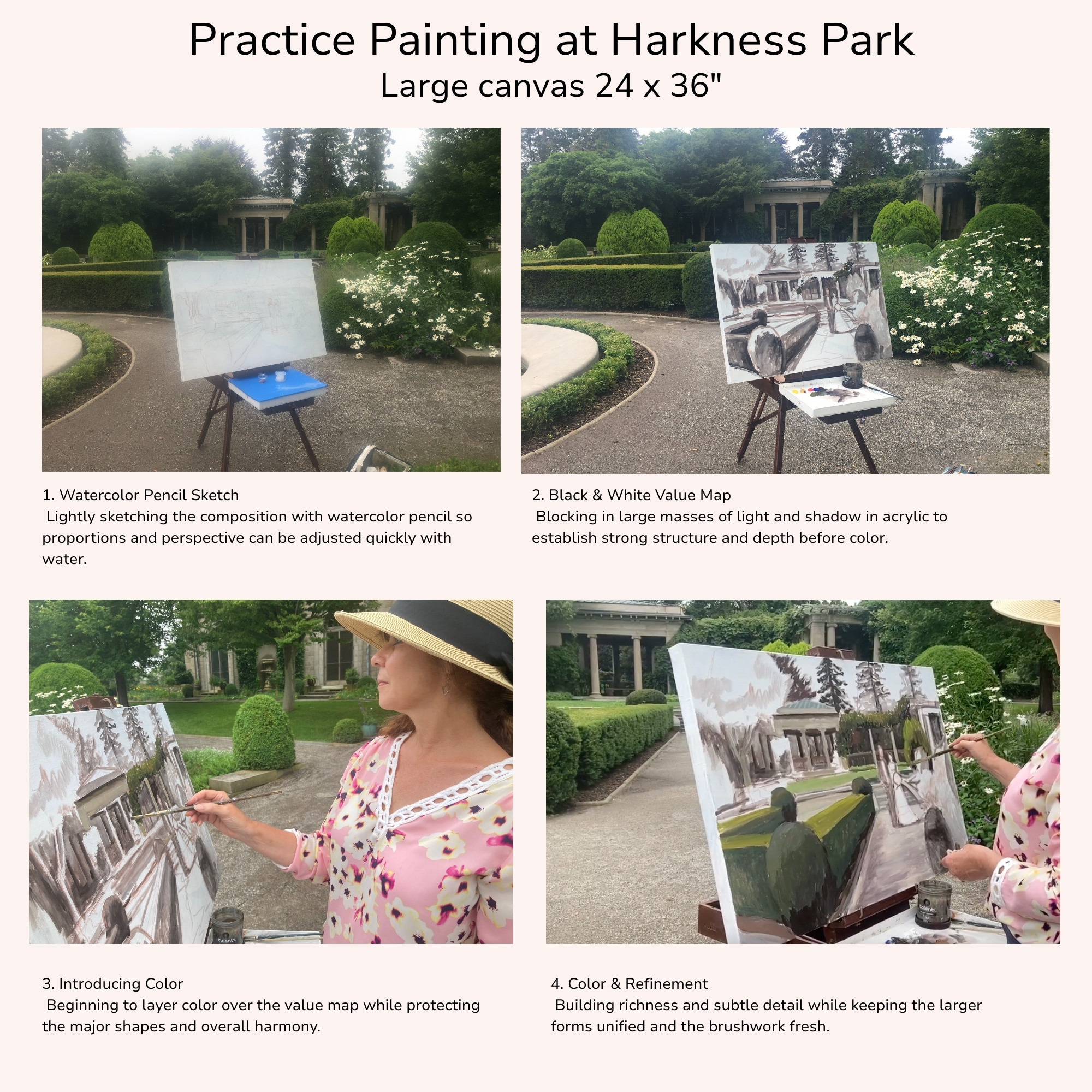
Step 1: Selecting the Location
When I arrive at a garden like Harkness, I don’t set up immediately.
I walk.
I look for:
- A strong focal point
- Clear light direction
- Architectural anchors
- Foreground, midground, and background layers
- Interesting value contrast
In this case, the columns, clipped hedges, and long perspective path gave me structure. The repeating shapes created rhythm. The darker trees framed the lighter architecture.
Composition first. Always.
Step 2: A Quick Sketch with Watercolor Pencil
On a large canvas outdoors, speed matters.
I often begin with a watercolor pencil sketch rather than traditional graphite. The reason is simple — flexibility.
If I need to adjust proportions, I can wipe out lines quickly with a damp brush. No eraser crumbs. No heavy scoring into the surface. It keeps the drawing light and adjustable.
At this stage, I focus on:
- Horizon line
- Major verticals (architecture, trees)
- Perspective lines
- Placement of large masses
This is not about details. It’s about structure.
Step 3: Blocking in a Black and White Value Map
Before color ever touches the canvas, I create a value map using black and white acrylic.
Especially when there is architecture and landscaping involved, value is everything.
If the value structure is correct:
- The proportions will feel grounded.
- The depth will read clearly.
- The eye will move naturally through the scene.
Large shapes first:
- Sky mass
- Tree canopy mass
- Building mass
- Pathway and hedge masses
I squint constantly to simplify. I’m not painting leaves or columns yet — I’m painting shapes of light and shadow.
When this stage is right, the painting already works — even without color.
Step 4: Adding Color on Top of Structure
Only after the value map feels solid do I introduce color.
Because the foundation is strong, the color can stay fresh and confident.
Large outdoor canvases teach you restraint:
- Keep the sky unified.
- Avoid overworking foliage.
- Protect your lights.
- Let the brushstrokes breathe.
This kind of training is essential when I step into a wedding setting with one chance to capture the moment.
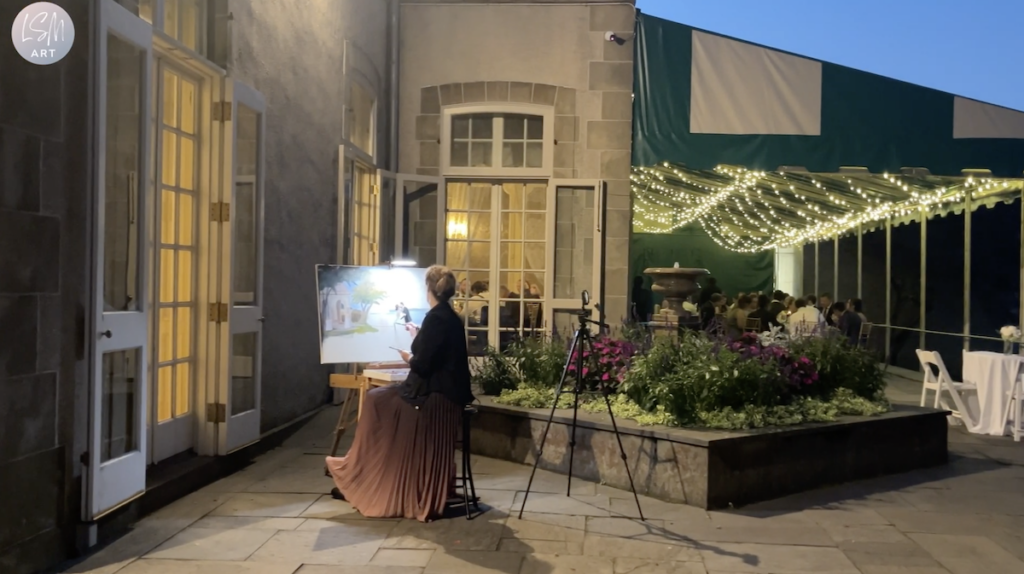
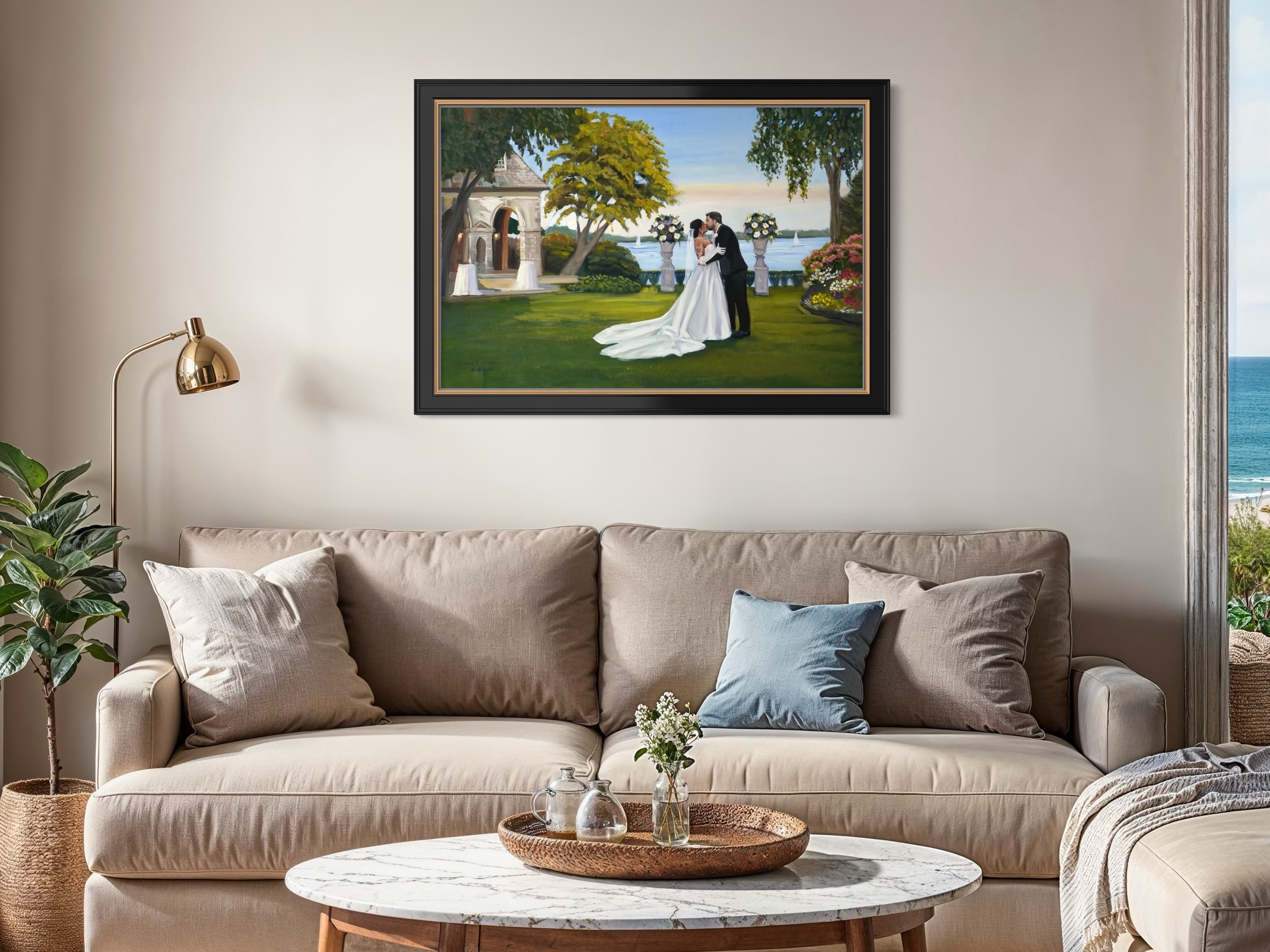
From Garden Practice to Julia & Steven’s First Kiss
Glen Manor House | September Wedding
Julia and Steven’s vision was very specific.
They wanted to capture:
- The end of their ceremony — their first kiss
- The florals on the pedestals
- A portion of the side garden on the right
- The water view behind them
- A glimpse of Glen Manor House on the left
It was a beautiful September day. Friends had traveled from all over to celebrate.
Because I’ve trained on large canvases outdoors, I was comfortable managing all those elements at once — architecture, landscaping, figures, florals, water, sky — without losing the intimacy of the couple.
I began painting from the back corner of the ceremony site to observe the moment clearly.
Later in the evening, I moved my easel to a small alcove on the outdoor patio. Guests naturally drifted outside for quieter conversations — and to watch the painting evolve. Those quieter moments are often my favorite part of the night.
Live painting is entertainment, yes.
But it is also discipline and preparation.
Experience is what turns that entertainment into an heirloom.
Watch the Highlight Video
Here is a short highlight from Julia and Steven’s wedding day:
Painting large outdoors strengthens the exact skills required to capture a wedding moment with confidence and grace.
And when a couple trusts me with their first kiss — surrounded by florals, architecture, and water views — I’m not guessing.
I’m drawing on years of structured practice.
Because these moments deserve to last.
For the Artist Who Feels Called to Paint Live Events
If you are an artist reading this and wondering what it truly takes to step into live event painting, know this:
It isn’t about speed.
It isn’t about finishing in a single night.
It’s about structure, preparation, value control, composition, and the discipline of practicing large outdoors long before the wedding day arrives.
Live event painting rewards artists who are willing to train — who understand perspective, who can simplify complex scenes, and who can build a painting in layers with confidence.
If you’ve been considering this path, start where I start:
Go outside. First Paint small then,
Paint large.
Build your value map first.
The rest grows from there.
If you have a question about live event painting — or something specific from this post about watercolor sketching, value mapping, or working large on location — leave it in the comments below.
I’d love to continue the conversation.
You might like one of these blog posts too
- A Live Painter’s Method for Transferring a Drawing to Canvas Quickly
- What Is an Artist Date? Refilling the Creative Well for Artists
- Live Wedding Painting at the Swan Club, Long Island – A Romantic Garden Scene
- Live Wedding Painting Indian Ceremony Boston MA | Aarohi & Aditya
- Why Practicing Large on Location Matters for Live Wedding Painting

Leave a Reply